
Brawl Stars Hypercharge Disparities Still Driving the Meta—and the Memes—in 2026
Brawl Stars’ hypercharge disparities create wildly inconsistent super charge times across brawlers, fueling strategic chaos and community debates.
I’ve been grinding Brawl Stars since 2018, and one thing never gets old: the sheer chaos of hypercharge mechanics. Back in 2023, the community was already buzzing about how wildly different brawlers fill their super meters, and fast-forward to 2026, not much has changed—except the jokes have gotten even better. Just last week, I dove into a thread on the official forums where a player named Far-Apple-7834 summed it up perfectly: “The disparity between some of these is crazy.” That post, originally from a few years ago, somehow feels fresher than ever. The conversation has evolved from bewildered observations to a full-blown strategic art form, and I’m here to break down why these charge-time quirks remain one of the game’s most entertaining and frustrating features.
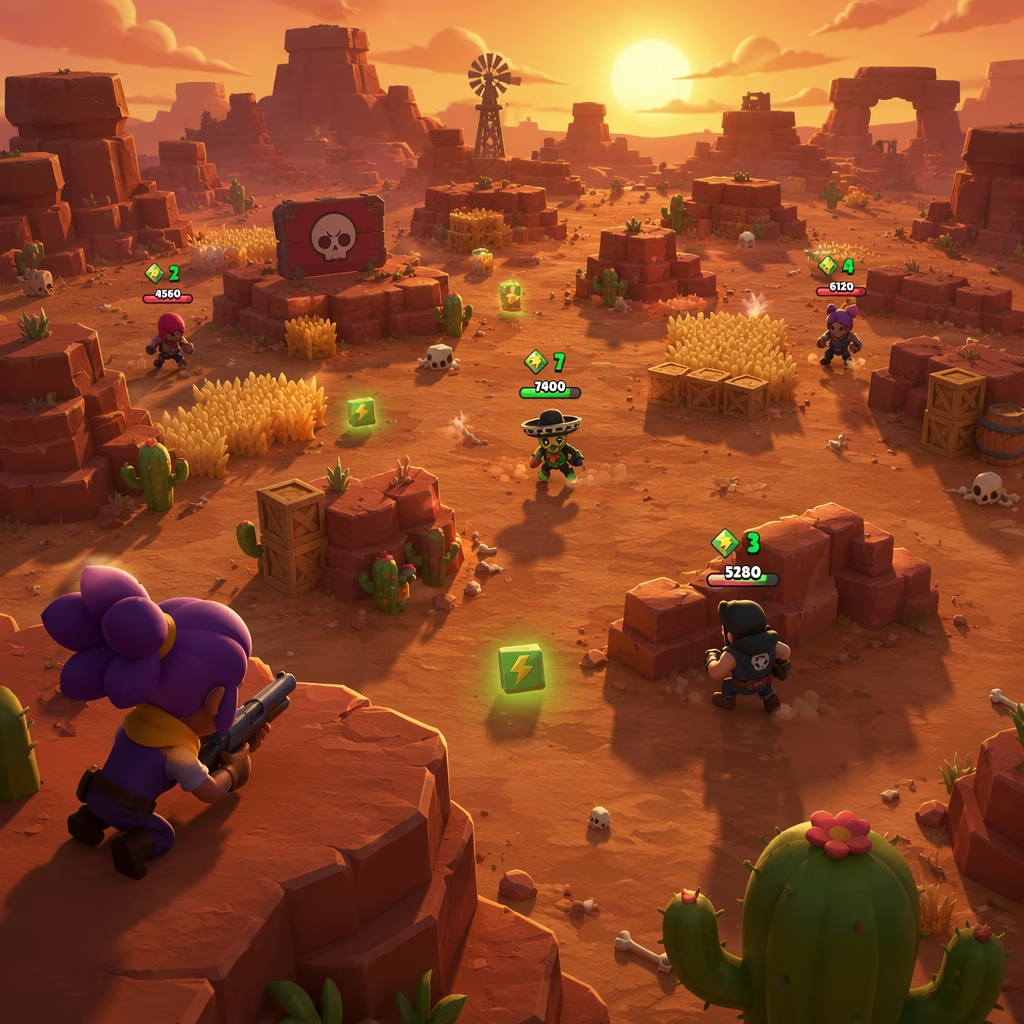
When you queue into a match today, you instantly feel the gap. Take Amber—poor Amber. Even in 2026, her hypercharge still crawls like a tortoise on a lazy Sunday. I’ve watched teammates spam attacks, desperately trying to light that meter, only to get wiped before the super ever pops. On the flip side, Bo’s charge rate remains a blink-and-you’ll-miss-it affair. I personally managed to fire off his hypercharge twice in a single Knockout round last night, and it felt borderline unfair. But that’s the beauty of Brawl Stars: the inconsistency breeds creativity. Some brawlers like Melodie can chain supers into teamwipes if you catch opponents off guard, while others, like Gus, become gem-grab monsters because you can cycle hypers two or even three times before the countdown ends.
The community’s reaction to this patchwork of charge speeds has always been a mix of salt and laughter. One Reddit user famously noted, “The fact that Gene and Mandy are polar opposites while having basically the same base coding is hilarious.” That observation has aged like fine wine. Even now, I chuckle every time I see a Gene hypercharge sail across the map in what feels like seconds, while Mandy players are still begging for scraps. The memes have only multiplied—there’s a running joke that some brawler charge rates are secretly tied to the alignment of the planets. It’s not all goofs, though. Players have turned these disparities into a science. Every season, the forums light up with tier lists ranking brawlers by “hyper efficiency,” and the debates get heated. Just last month, a vocal group of Penny mains demanded a rework because her charge time felt “slower than a snail in molasses,” while Colt enthusiasts argued their brawler was perfectly balanced since skill shots sped things up considerably.
What fascinates me most is how hypercharge disparities have shaped the meta at every level. In competitive play, team compositions now revolve around who can cycle supers the fastest. A common lineup I see in Power League pairs a rapid charger like Edgar with a supportive tank like Frank, creating a pressure cooker where the enemy team can’t breathe. Meanwhile, casual modes like Brawl Ball have become showcases for Showdown-style hypercarries—players lock in brawlers like Leon or Crow, knowing they can pop off multiple hypers and swing the game solo. Strategies evolve constantly, and I’ve had to unlearn old habits more times than I can count. The introduction of new brawlers keeps things spicy, too. The 2026 addition of Kael, a mythic assassin, comes with a hypercharge that charges fastest when you’re below half health, flipping risk-reward dynamics on their head.
Of course, balance discussions never truly end. Some players call for a universal hypercharge rate, but that would erase the identity of so many brawlers. I sympathize with the purists who argue that variance forces smarter play—you wouldn’t throw a slow-charging Mortis into a heist and expect miracles. Still, the dev team has been responsive, tweaking rates incrementally with each balance patch. A recent update shaved 0.8 seconds off Piper’s baseline charge time, and suddenly she’s a menace again. These changes keep the community engaged, and I love reading the patch notes like a morning newspaper.
In the end, the hypercharge debate captures everything great about Brawl Stars. It’s messy, hilarious, and deeply competitive. Whether I’m laughing at a Gene zooming past my stunned teammate or sweating over a clutch Bo hyper in overtime, I know the chaos is here to stay. The game may have evolved, but the heart of the community remains the same: we’ll complain about slow chargers, meme about the outliers, and secretly love every second of it. The next time you’re in a match and your super meter fills in a flash, take a moment to appreciate the beautiful imbalance—and maybe send a prayer to the players stuck on the other end.
Key Hypercharge Charge Rates (Community Perceptions, 2026 Season 14)
| Brawler | Charge Speed | Typical Mode Impact |
|---|---|---|
| Amber | Very Slow | Struggles to cycle in Gem Grab, often reliant on teammate shielding |
| Bo | Very Fast | Can charge twice in Knockout, excellent area denial |
| Melodie | Fast | Teamwipe potential in Brawl Ball with tight corridors |
| Gene | Moderate-Fast | Pulls enemies frequently, controls zone in Hot Zone |
| Mandy | Slow | Requires careful positioning, high-risk high-reward |
| Gus | Fast | Dominates Gem Grab, multiple hypers per game |
| Kael (New) | Conditional | Charges faster at low HP, promotes aggressive dives |
These disparities aren’t bugs—they’re features that keep billions of matches unpredictable. So the next time you get steamrolled by a hypercharged Edgar, remember: somewhere, an Amber main is still waiting for their first super. And that’s peak Brawl Stars.